Friday, 30 October 2026

Eczema vs. psoriasis: How to tell these common skin conditions apart

From keyt.com/stacker-medical-care

By Veronica Hackethal for Doctronic

If you’ve noticed red, scaly patches on your skin, you might be wondering whether you’re dealing with eczema or psoriasis. These two common inflammatory skin conditions share many similarities, making them notoriously difficult to distinguish at first glance. Here, Doctronic explains how to tell the two apart.

Both can cause dry, irritated skin that significantly impacts your quality of life. However, understanding the key differences between these conditions is crucial for receiving the right treatment and managing your symptoms effectively. While over 30 million Americans live with eczema and 8 million have psoriasis, many people struggle to identify which condition they actually have, leading to delayed or inappropriate treatment. 

  • Eczema and psoriasis are distinct inflammatory skin conditions that are often confused due to similar appearances.
  • Location patterns differ significantly: psoriasis favours outer elbows and knees, while eczema appears in skin folds and creases.
  • Eczema causes intense itching, while psoriasis typically produces burning or stinging sensations.
  • Both involve immune system dysfunction but through different inflammatory pathways, requiring targeted treatments.

Understanding What Each Condition Looks Like


The visual differences between eczema and psoriasis become more apparent when you know what to look for. Eczema, particularly atopic dermatitis, typically presents with ill-defined borders and can vary significantly based on your skin tone. On lighter skin, eczema appears as pink or red rashes with bumps and crusting, while on darker skin tones, it may look dark brown, grey, or purple with dry, small bumps.

Psoriasis, in contrast, has a much more distinctive appearance characterized by well-defined, thick red plaques topped with silvery-white scales. These patches look like they have layers of scaly build-up on top of the underlying redness. The scaling occurs because psoriasis causes your skin cells to grow too rapidly, creating an excess build-up that your body cannot shed quickly enough. This results in the characteristic thick, raised patches that feel different to the touch compared to eczema’s typically flatter appearance.

The texture differences are equally telling. Psoriasis patches tend to be significantly thicker and more inflamed than eczema lesions. While eczema may present with some scaling, it’s typically much lighter and less pronounced than the prominent silvery scales seen in psoriasis.

Location Patterns Reveal Important Clues


One of the most reliable ways to distinguish between these conditions is examining where they appear on your body. Psoriasis shows a strong preference for specific areas, most commonly affecting the outer edges of your elbows and knees, scalp, lower back, and the soles of your feet and palms. It may also appear on your ears, around your mouth, on your eyelids, buttocks, or affect your nails.

Eczema follows a completely different pattern, favouring the skin folds or creases of your body. You’ll most commonly find eczema symptoms in areas like the inner elbows, behind the knees, around your wrists, neck, and ankles. Eczema is also much more likely to affect your face and neck compared to psoriasis. In babies, eczema frequently appears on the chin, cheeks, scalp, chest, arms, and legs, while adults often experience symptoms on their faces or hands.

This location preference isn’t just coincidental. It reflects the different underlying mechanisms of each condition. Eczema tends to develop in areas where skin is more sensitive or prone to irritation from friction and sweating, while psoriasis often affects areas that experience more mechanical stress or trauma. Understanding these patterns can help you and your healthcare provider make a more accurate diagnosis, especially when combined with other distinguishing factors.

Symptoms and Sensations: Beyond the Visual


While both conditions can cause discomfort, the type and intensity of symptoms differ significantly. Eczema is notorious for causing intense itching that can be particularly severe at night, often disrupting sleep patterns. This itching can become so intense that it leads to a cycle of scratching and further skin damage. The itch associated with eczema is often described as relentless and can significantly impact daily activities and quality of life.

Psoriasis, on the other hand, may not cause itching at all. When it does, the sensation is typically described as more of a burning or stinging feeling rather than the intense itch characteristic of eczema. Some people with psoriasis report mild itching, but it’s generally not the overwhelming sensation experienced with eczema. Instead, psoriasis patches may feel tight, painful, or cause a burning sensation.

The difference in symptoms extends beyond just itching. Eczema can sometimes present with oozing or weeping lesions, especially during active flares or when the skin barrier is severely compromised. This can lead to crusting as the lesions heal. Psoriasis rarely presents with oozing; instead, you might notice bleeding when scales are removed or if the thick skin cracks.

Age of Onset and Demographics


The timing of when these conditions first appear can provide valuable diagnostic clues. Eczema is predominantly a childhood condition, with most cases beginning before age 5. Many children with eczema find that their symptoms improve or even disappear as they reach adulthood, though some continue to experience symptoms throughout their lives.

Psoriasis typically develops later, most commonly appearing after age 18, though it can occur at any age. Unlike eczema, psoriasis tends to be a lifelong condition that requires ongoing management. However, both conditions can have periods of improvement and flare-ups throughout a person’s life.
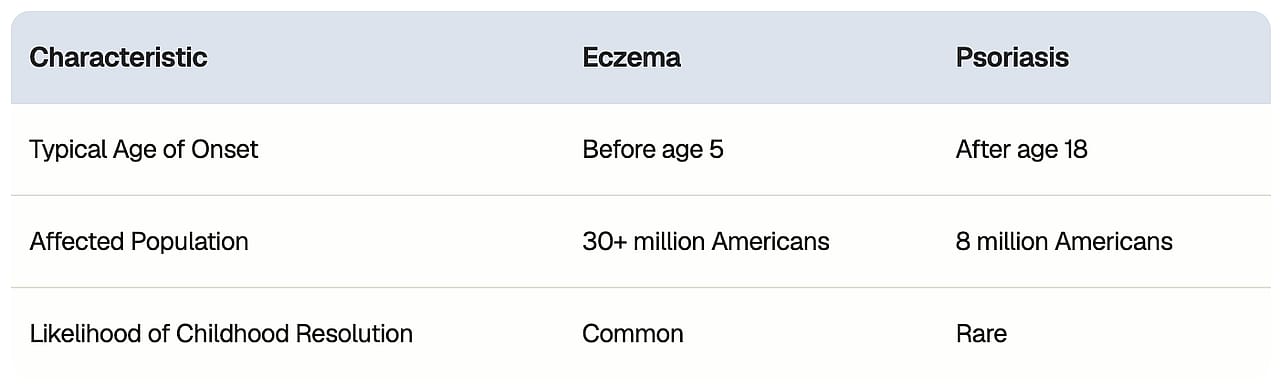
Table defining characteristics of eczema and psoriasis.
Doctronic

These demographic differences reflect the distinct nature of each condition. Understanding whether eczema is an autoimmune disease helps explain why it often begins in childhood when the immune system is still developing, while psoriasis’s autoimmune nature typically manifests later when genetic predispositions combine with environmental triggers.

The Immune System Connection


Both eczema and psoriasis involve immune system dysfunction, but they affect different immune pathways. This distinction is crucial for understanding why certain treatments work for one condition but not the other. Eczema is primarily driven by T Helper 2 (TH2) cells, which are associated with allergic-type inflammation. This explains why people with eczema often have other allergic conditions like asthma or hay fever.

Psoriasis, conversely, is driven by Th1 and Th17 cells, which are part of the immune system branch involved in fighting fungal and bacterial infections. This different immune pathway explains why psoriasis causes the characteristic rapid skin cell growth and thick scaling that distinguishes it from eczema.

These immune differences have significant implications for treatment. Biologic medications, which target specific immune pathways, are designed to work for either eczema or psoriasis, but not both. This is why accurate diagnosis is essential before starting advanced treatments. Whether you’re dealing with breast eczema, penile eczema, ear eczema, or other forms, getting the right diagnosis ensures you receive the most effective treatment approach. 

The Bottom Line


Understanding the differences between eczema and psoriasis empowers you to seek appropriate treatment and manage your skin condition effectively. While both conditions can significantly impact your quality of life, accurate diagnosis is the first step toward relief. Key distinguishing factors include location patterns, type of symptoms, age of onset, and underlying immune mechanisms. Remember that these conditions require different treatment approaches, from basic skincare routines to advanced therapies, such as medication, for eczema management.

This story was produced by Doctronic and reviewed and distributed by Stacker.


https://keyt.com/stacker-medical-care/2026/10/29/eczema-vs-psoriasis-how-to-tell-these-common-skin-conditions-apart/

Tuesday, 27 October 2026

Belgium: Psoriasis Day aims to break down taboos around rare skin disease

From brusselstimes.com

AbbVie and the French-speaking patient group Psoriasis-Contact are launching a campaign on 29 October, World Psoriasis Day, to break the taboo around genital psoriasis and encourage patients to speak openly about it.

Psoriasis, a chronic inflammatory skin condition, affects 2% to 3% of the Belgian population. Studies suggest that up to 63% of people with psoriasis experience genital symptoms at some point in their lives.

Yet almost half of those affected have never discussed the problem with their doctor. In Belgium, it takes an average of two and a half years for the condition to be diagnosed.

Symptoms such as itching, redness, burning and pain can easily be mistaken for irritation, thrush or a sexually transmitted infection. Dermatologist Lisa Goldberg said an accurate diagnosis was essential to ensure patients received the right treatment.

Under European guidelines, genital involvement alone is enough for psoriasis to be classified as moderate to severe. This can justify the use of systemic treatment.

The condition can also have a serious impact on self-confidence, sexual desire and relationships. Sexologist Laurane Wattecamps said shame often caused more harm than the pain itself, adding that people with genital psoriasis could still have a full and satisfying intimate life.

The campaign, called C’est la gêne, includes posters and leaflets in waiting rooms, as well as a dedicated website with information about the disease. A podcast featuring dermatologists, sexologists and patients discussing the illness and intimacy is also available on major audio platforms.

The organisers said patients’ need for information and support remained largely unmet, and that the taboo surrounding this form of psoriasis had become a real societal issue.

Psoriasis-Contact, a volunteer-run non-profit organisation, has been active in Brussels and Wallonia for the past 10 years.

https://www.brusselstimes.com/health-news/2377338/psoriasis-day-aims-to-break-down-taboos-around-rare-skin-disease 

Friday, 23 October 2026

Dermatologist Dr. Philip Werschler Discusses Expert Psoriasis Care and Management Tips

From medicaldaily.com

Psoriasis affects about 3.2 percent of adults in the United States, and the people living with it know it's rarely just a skin problem. Good psoriasis care starts with understanding that it's a chronic, immune-driven condition that often reaches beyond the skin. It also means working with a provider who can match treatment to severity over time.

Wm. Philip Werschler, MD is a board-certified dermatologist with more than 30 years of clinical experience and a long record as an FDA clinical trial investigator. He's a founding member of the American Society of Cosmetic Dermatology and Aesthetic Surgery and the founding Editor-in-Chief of the Journal of Clinical and Aesthetic Dermatology (JCAD). Additionally, Dr. Werschler serves as a professor of dermatology at the University of Washington and Washington State University medical schools. During his seasoned career and through extensive research, he has treated thousands of psoriasis patients and shares his expertise on managing the condition.

Understanding Psoriasis as a Chronic Condition

Psoriasis is a chronic immune-mediated disease that's been linked to other health conditions, and managing it well means looking past the visible plaques. The skin changes happen because the immune system tells skin cells to grow far faster than normal. Those cells pile up and form the raised, scaly patches most people know.

Plaque psoriasis is the most common type, making up about 90 percent of cases. Other forms include guttate, inverse, pustular, and erythrodermic psoriasis. Each one looks different and may need a different approach.

Because psoriasis raises the risk of heart disease, obesity, diabetes, and depression, it's treated as a long-term condition rather than something that can be cleared once and forgotten. Flares can come back after months or even years of calm, and triggers shift over a lifetime. Ongoing care, regular skin checks, and teamwork with a primary care provider help patients stay ahead of both the disease and the health risks tied to it.

How Dermatologists Assess Psoriasis Severity

Dr. Werschler explains that specialists most often use the Psoriasis Area and Severity Index, or PASI, to grade severity. PASI measures how much of the body is affected along with the redness, thickness, and scaling of plaques. It sorts cases into mild, moderate, or severe categories.

Severity matters because it shapes which treatments make sense and which therapies insurance will cover. Location of plaques is also a key factor. Plaques on the scalp, nails, palms, soles, or genital area often need a special approach, even when the total skin area involved is small.

A full evaluation also includes screening for psoriatic arthritis, which develops in about one in three people with psoriasis. Joint inflammation can start quietly with stiffness or swelling in the fingers or toes, and untreated psoriatic arthritis can cause permanent joint damage. Catching it early gives patients the best shot at keeping their joints working well.


What Are the Main Treatment Options for Psoriasis?

As Dr. Werschler notes, psoriasis care today includes five main types of treatment: topical therapies, phototherapy, oral medications, injectable biologics, and medicated shampoos for scalp involvement. Most plans incorporate more than one, he explains, and the right mix depends on severity, where the plaques are, health history, and how the disease responds over time.

Topical therapies

For mild to moderate psoriasis, a topical psoriasis cream is usually the first step. Options include corticosteroids, vitamin D analogues like calcipotriene, topical retinoids, and calcineurin inhibitors.

Dr. Werschler notes that there are several newer topical treatments, including roflumilast and tapinarof. "These medications may be referred to as 'steroid sparing' because they are cortisone-free and have fewer side effects, especially with prolonged use. Generally, the use of steroid creams is limited to non-facial and non-genital areas of the body."

Many patients rotate between products to balance how well they work with how the skin tolerates them.

Phototherapy

Controlled exposure to ultraviolet light, most often narrowband UVB, can clear widespread mild to moderate plaques. Treatment can happen in a clinic or with a prescribed home unit.

While phototherapy is used less today, it remains a viable option for some patients, although it is not considered a systemic therapy that treats psoriatic arthritis. For fair-skinned individuals, it may increase the risk of skin cancer, especially with prolonged use.

Oral medications

Methotrexate, cyclosporine, and deucravacitinib are used for moderate to severe disease. Each one needs monitoring through regular lab work and follow-up visits.

Apremilast is an oral medication FDA-approved for mild to moderate psoriasis and psoriatic arthritis. Apremilast does not require any specific laboratory monitoring and is generally well tolerated. Some patients may experience gastrointestinal side effects such as nausea and diarrhoea.

A newer oral psoriasis medication, icotrokinra, was recently approved by the FDA. This medication targets a similar part of the immune system as some injections, known as an IL-23 blocker. This medication must be taken every day on an empty stomach and 30 minutes before eating. The most common side effects include headache, nausea, cough, fungal infections, and fatigue.

Injectable biologics

This newer class targets specific immune signals involved in psoriasis and is approved for moderate to severe cases. Biologics have become a mainstay of therapy for many psoriasis patients.

Medicated shampoos

Scalp psoriasis often responds to over-the-counter or prescription shampoos with coal tar, salicylic acid or ketoconazole, sometimes paired with a topical steroid.

Treatment rarely stays the same. As the disease changes, as new therapies come out, and as patients move through different life stages, the plan should change with them.

When Biologics Become the Right Choice

Biologics aren't the starting point for every patient. They're reserved for moderate to severe psoriasis, usually after topical therapy and oral medications haven't delivered enough relief. Instead of broadly suppressing the immune system the way older drugs do, newer biologics target specific immune pathways involved in psoriasis. As a result, they often produce clearer skin with fewer side effects when properly monitored.

Before starting a biologic, patients are screened for active infections, tuberculosis exposure, and any health conditions that could affect safety. Regular follow-up keeps treatment on track, and serious complications are uncommon with proper care.

Choosing among the available biologics is where research experience makes a difference. Having served as a principal investigator on many FDA approved psoriasis clinical trials through Premier Clinical Research in Spokane, Dr. Werschler's work shapes how he weighs efficacy data, how long a response lasts and patient-specific factors when guiding these decisions.

Lifestyle Factors That Make Psoriasis Worse (and Better)

Dr. Werschler points out that there are seven lifestyle factors that consistently affect psoriasis: stress, smoking, alcohol, skin injury, body weight, certain medications, and sun exposure. Daily habits won't replace medical treatment, but they can make a real difference in how often flares happen and how well treatment works.

  • Stress is one of the most commonly reported triggers, and stress management techniques can ease flare intensity.
  • Smoking and alcohol are both tied to more severe disease and a weaker response to treatment.
  • Skin injury can trigger new plaques at the site of cuts, scrapes or sunburn. This pattern is called the Koebner phenomenon.
  • Weight plays a role too. Obesity is linked to more severe psoriasis, and losing weight often improves how patients respond to treatment.
  • Certain medications can make the disease worse, including beta-blockers, lithium, antimalarials, and some anti-inflammatory drugs. Patients should always tell their dermatologist about every prescription and supplement they take.
  • Dry skin fuels itching and scaling. Heavy moisturizers, ointments, or petroleum jelly applied to damp skin after bathing help seal in moisture.
  • Sun exposure in small amounts can briefly improve plaques, but sunburn triggers flares. Broad-spectrum SPF 30 or higher on unaffected skin and limited time in peak sun are the safer choice.

Dr. Werschler also notes that because long-term inflammation can raise heart disease risk, patients with moderate to severe psoriasis benefit from heart health screening as part of regular care. Working with both a dermatologist and a primary care provider helps catch related conditions early.

Building a Psoriasis Care Plan That Works

Psoriasis is chronic, but Dr. Werschler says it's far more manageable than it was even a decade ago. The range of available therapies has expanded, and patients who once cycled through limited options now have real choices at every severity level. According to Dr. Werschler, success starts with an accurate diagnosis, an honest look at severity, and a plan built around the patient.

For anyone whose psoriasis hasn't responded to first-line treatments, a visit with a board-certified dermatologist is often the turning point. Beyond clearing skin, the right plan has the power to protect long-term health.

https://www.medicaldaily.com/dermatologist-dr-philip-werschler-discusses-expert-psoriasis-care-management-tips-480246

Tuesday, 20 October 2026

Psoriasis beyond skin: What patients need to know about associated health risks

From news9live.com

By Sangeeta Das

Psoriasis affects more than the skin, increasing the risk of joint problems, heart disease and other health concerns. Find out the associated risks and treatment options


New Delhi: Psoriasis is often mistaken for a skin condition characterised by red, scaly patches, but its impact extends far beyond the skin. It is a chronic, immune-mediated inflammatory disease that can affect multiple organ systems. Recognising these associations is essential for protecting a patient’s long-term health.


Psoriatic arthritis: Recognising early signs

One of the most important conditions associated with psoriasis is psoriatic arthritis. Patients may experience joint pain, stiffness, swelling of the fingers or toes, and morning stiffness that improves with movement. In my clinical experience, one important point patients often overlook is that psoriatic arthritis can sometimes develop before the characteristic skin lesions appear. Persistent joint pain, swelling or changes in the joints and bones warrant medical assessment. Even a seemingly minor rash, scalp scaling or nail changes may offer valuable diagnostic clues. Consulting a dermatologist can help identify subtle signs of psoriasis, while early collaboration with a rheumatologist can prevent irreversible joint damage.

Cardiometabolic and cardiovascular risks

Psoriasis is also associated with an increased risk of cardiometabolic disorders, including obesity, type 2 diabetes, hypertension and abnormal cholesterol levels. Chronic systemic inflammation is thought to contribute to these associations. Patients, particularly those with moderate-to-severe disease, should undergo appropriate screening for blood pressure, blood glucose, lipid levels and excess body weight.

Cardiovascular health deserves particular attention. People with psoriasis, especially severe disease, may have a higher risk of heart attacks and strokes. Dermatologists must therefore look beyond visible plaques and encourage patients to address smoking, physical inactivity, excess weight and unhealthy dietary habits.

Impact on mental health

Mental health is equally important. Persistent itching, visible lesions and unpredictable flare-ups can affect self-esteem, relationships and social interactions. Anxiety and depression are not uncommon. Patients should feel comfortable discussing these concerns, as effective treatment can improve both symptoms and quality of life.

Psoriasis and liver health

Psoriasis has also been linked to metabolic dysfunction-associated steatotic liver disease (MASLD), previously called non-alcoholic fatty liver disease. Certain systemic treatments may require liver monitoring, making individualised assessment essential.

Managing psoriasis beyond skin

The encouraging news is that psoriasis can be managed with topical treatments, phototherapy, conventional systemic medicines and biologic therapies, depending on disease severity and associated conditions.

Regular follow-up, screening for relevant comorbidities and collaboration between dermatologists, rheumatologists and physicians can make a meaningful difference.

The central message is simple: treating psoriasis means treating the patient, not just the patches. A comprehensive approach can help control inflammation, identify associated health risks early and improve long-term well-being.

(By Dr Deepali Bhardwaj, Senior Consultant, Dermatology, Max Hospital, Saket)

Disclaimer: This article is written by the doctor mentioned above. The findings should not be considered medical advice or used for self-diagnosis or treatment. Consult a qualified healthcare professional for personalised guidance.

https://www.news9live.com/health/psoriasis-associated-health-risks-early-signs-3017093

Sunday, 18 October 2026

When the Cold Takes a Toll on Your Skin

From tovima.com

Cold, dry air and indoor heating can trigger flare-ups of eczema, psoriasis and other skin conditions, while persistent cold-related lesions may sometimes point to an underlying autoimmune or vascular disorder

Cold weather, dry air outdoors and indoor heating create a particularly harsh environment for the skin. For most people, this may simply mean increased dryness. For people with atopic dermatitis, eczema, psoriasis or other skin conditions, however, winter can bring genuine flare-ups.

“Winter and cold weather significantly affect the skin, mainly because cold, dry air, combined with low humidity and increased indoor heating, disrupts the skin barrier and increases dryness and irritation,” Sotirios Theocharis, president of the Hellenic Society of Dermatology and Venereology, tells TO BHMA.


From Eczema and Psoriasis to Rosacea

At the top of the list of those most vulnerable are patients with atopic dermatitis and eczema in general. Flare-ups are also more common with seborrheic dermatitis.

“Psoriasis can flare up in a significant proportion of patients during the cold and dry months. However, there is no single rule that applies to all patients, as the disease’s seasonal pattern varies considerably from person to person,” Theocharis notes.

Rosacea can also be aggravated. The inflammatory skin condition affects the face and can cause visible small blood vessels, inflammatory lesions and a burning sensation.

There are also conditions that are much more directly linked to exposure to cold, such as cold urticaria and the familiar chilblains, also known as pernio. Here, too, a seemingly simple skin lesion can sometimes be a sign that further investigation is needed.

When the Cold Reveals Something More

“There is a particular category we need to keep in mind: chilblain lupus, a form of cutaneous lupus erythematosus in which lesions on the fingers and other areas of the extremities appear or worsen in the cold. Chilblains can also occur secondarily in patients with systemic autoimmune or other diseases. That is why persistent, recurring or atypical lesions require medical evaluation,” Theocharis stresses.

Raynaud’s phenomenon is also of particular interest. According to Theocharis, it affects 2% to 4% of the general population and is characterized by sudden changes in the colour of the skin on the extremities.

“It should be investigated for the possible presence of a systemic disease,” he says. The key, however, is not to assign the cold a causal role that it does not have.

“Cold is not, by itself, the cause of all these diseases. In many cases, it acts as a factor that disrupts the skin barrier, causes vasospasm or triggers a flare-up of an existing skin condition.”

No Single Treatment for “Winter Skin Conditions”

Precisely because these are different diseases, there is no single winter treatment.

For dry skin and eczema, the first goal is to restore the skin barrier through the regular use of appropriate moisturizing and emollient products, while avoiding very hot water and irritating cleansers. When inflammation is present, treatment should be determined by a dermatologist.

“For atopic dermatitis, there are now many effective treatments, ranging from topical therapies to phototherapy and modern targeted systemic treatments. In psoriasis, treatment is tailored according to the extent and severity of the disease and may include topical treatments, phototherapy or systemic therapy, including newer biologic and other targeted treatments,” he says.

For chilblains, by contrast, the first step is protection from the cold and gradual rewarming of the extremities. Persistent or recurring lesions require evaluation for a possible underlying disease. In cases of chilblain lupus, cooperation between a dermatologist and a rheumatologist may even be necessary.

The Mistakes We Make When It Gets Cold

Everyday prevention is much simpler. Warm clothing, gloves and socks, protection for the face and ears, and avoiding prolonged exposure to very low temperatures form the first line of defence.

“Proper skin moisturization is equally important. Gentle cleansers are recommended, along with applying a good moisturizer immediately after bathing and reapplying it during the day when there is dryness. Bath water should not be very hot, and baths should not be prolonged,” Theocharis says.

Another mistake is trying to warm up frozen hands or feet abruptly with very hot water or by placing them against a radiator.

“Rewarming should be gradual,” he warns.

As for diet, he dismisses the idea that there is a special diet that protects the skin during winter.

“There is no specific ‘winter diet’ that prevents skin diseases.”

A balanced diet is sufficient, while arbitrary food restrictions or supplements are not recommended without a specific indication. One exception is psoriasis, for which there is evidence that weight loss in overweight or obese patients may reduce the severity of the disease.

Have skin conditions increased?

Theocharis is cautious on this point as well. In everyday clinical practice, dry skin, eczema and worsening of chronic skin conditions are frequently observed during the colder months.

That, however, is not enough to conclude that dermatological diseases overall have increased in recent years, as comparable epidemiological data would be required.

“What is certain is that the winter months are a period when many patients with chronic skin conditions need greater care and adjustments to their daily skin-care routine.”

The message he says people should take away is simple:

“Cold does not cause most skin diseases by itself, but it can disrupt the skin barrier, trigger flare-ups and, in some cases, reveal an underlying vascular or autoimmune disorder.”

https://www.tovima.com/society/when-the-cold-takes-a-toll-on-your-skin/